
A Monday Morning, Two Years Apart
In 2022, Laura started her day the same way she always did.
Open ERP.
Download CSV.
Rename file.
Paste into accounting system.
Fix column misalignment.
Reply to three emails asking for the same report.
She didn’t hate her job. She hated the repetition.
So the company implemented automation. Suddenly, a digital worker logged in, clicked the same buttons, downloaded the same file, and pasted the same data.
Productivity skyrocketed.
Two years later, the process broke.
The ERP added a new column. The bot failed.
Someone sent a PDF instead of a CSV. The bot failed.
An email subject changed slightly. The bot failed again.
The automation team fixed it each time — until leadership asked a simple question:
“Why does our automation still behave like an intern that memorized steps instead of an employee that understands work?”
That question marks the shift from RPA (Robotic Process Automation) to APA (Agentic Process Automation).
What RPA Was Designed For
Definition
Robotic Process Automation (RPA) automates deterministic, rule-based digital tasks by mimicking human actions in user interfaces.
It does not understand tasks.
It reproduces them.
Think of RPA as a perfect imitator.
The Original Purpose
RPA solved a specific industrial-era problem inside modern offices:
Humans were acting like APIs between systems that were never designed to communicate.
People copied, pasted, downloaded, renamed, uploaded, reconciled, and retyped data across applications. Not because it required thinking — but because software architecture demanded it.
RPA’s mission was simple:
Remove humans from mechanical digital labor.
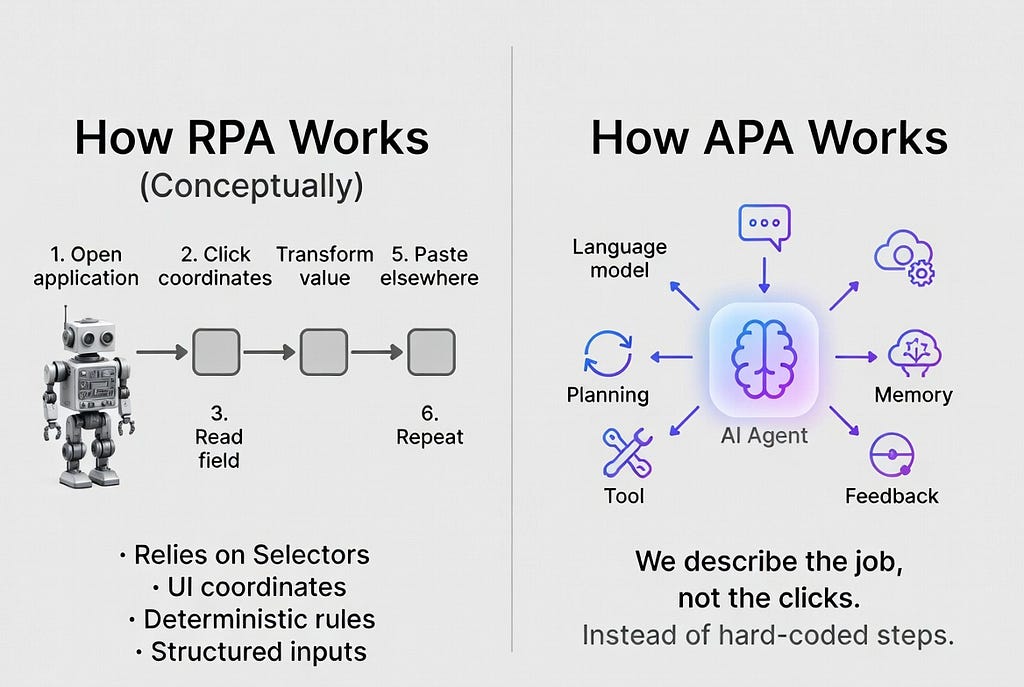
How RPA Works (Conceptually)
RPA follows an explicit script:
- Open application
- Click coordinates
- Read field
- Transform value
- Paste elsewhere
- Repeat
It relies on:
- Selectors
- UI coordinates
- Deterministic rules
- Structured inputs
Where RPA Excels
RPA is extremely effective when:
- Inputs are structured
- Steps never change
- Decisions are binary
- Interfaces remain stable
Real Examples
Finance
- Invoice posting from standardized PDFs
- Bank reconciliation with fixed layouts
- Payroll export/import
HR
- Employee onboarding forms
- ID generation
- Benefits enrollment transfers
Operations
- Order entry from web portals
- Shipment tracking updates
- Inventory synchronization
Analogy
RPA is like a player piano.
Insert the correct roll, and it performs perfectly.
Change the music slightly — it stops making sense.
The Limits of Imitation
Companies discovered a paradox:
They automated tasks… but not work.
Why?
Because real processes are not deterministic.
They include:
- Emails written in natural language
- Exceptions
- Ambiguity
- Missing information
- Judgment
- Interpretation
The moment variability enters the process, RPA becomes fragile.
Organizations compensated by adding:
- More rules
- More exception branches
- More maintenance
Eventually, automation cost began rising again.
The problem wasn’t automation.
It was the model of intelligence behind it.
RPA automates steps.
Businesses need automation that handles intent.
The Emergence of APA
Definition
Agentic Process Automation (APA) automates goal-oriented workflows using autonomous agents capable of reasoning, interpreting context, and adapting actions dynamically.
RPA asks:
“What are the steps?”
APA asks:
“What is the objective?”
From Script to Intent
Instead of programming a sequence, APA defines:
- Goal
- Constraints
- Available tools
- Knowledge sources
The agent decides the path.
Analogy
If RPA is a player piano,
APA is a musician.
Both produce music.
Only one understands it.
How APA Works
An agentic system typically combines:
- Language models — interpret meaning
- Planning mechanisms — decide actions
- Tool usage — execute operations
- Memory — maintain context
- Feedback loops — self-correct
Instead of hardcoding logic:
We describe the job, not the clicks.
Example: The Same Process, Reimagined
Task: Process incoming supplier invoices
RPA Approach
Rules:
- If email subject contains “Invoice”
- Download attachment
- Extract fixed fields
- If format differs → send to human
Outcome:
Works perfectly until it doesn’t.
APA Approach
Goal:
“Record payable obligations accurately in the accounting system.”
Agent behavior:
- Reads email
- Understands whether it’s an invoice
- Interprets attachment (PDF, image, text, portal link)
- Finds missing data via vendor history
- Queries ERP API
- Requests clarification if uncertain
- Logs reasoning for auditability
Outcome:
Not step automation — work automation.
Why APA Naturally Emerged
RPA reached a ceiling called process brittleness.
The business world runs on semi-structured information:
- Conversations
- Documents
- Decisions
- Negotiations
- Interpretation
Generative AI introduced machine reasoning over unstructured data.
Once machines could understand instructions, the automation paradigm changed:
We stopped automating interfaces.
We started automating responsibilities.
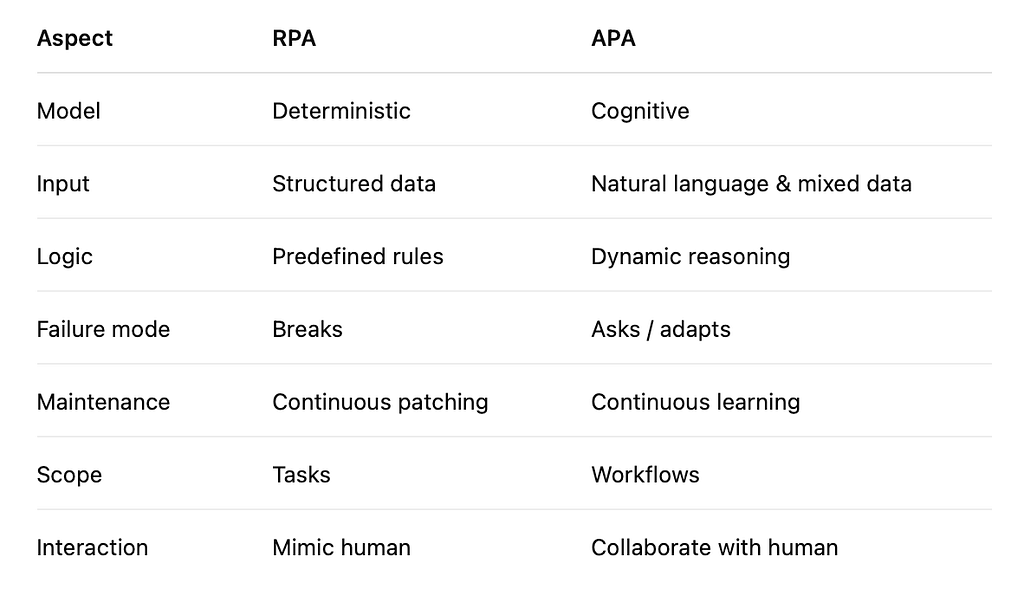
The Conceptual Shift
Practical Applications of APA
1. Customer Support Resolution
Not just classify tickets — solve them.
Agent:
- Reads conversation
- Queries knowledge base
- Executes refunds
- Schedules technicians
- Escalates only edge cases
2. Sales Operations
Instead of CRM data entry automation:
Agent:
- Analyzes meeting transcript
- Updates CRM fields
- Generates follow-ups
- Schedules next steps
- Predicts deal risk
3. Internal Knowledge Navigation
Employees don’t search documents anymore.
They ask:
“How do I approve an international supplier contract under compliance policy?”
Agent:
- Interprets policy
- Verifies context
- Generates action steps
- Launches workflow
4. Financial Close
Rather than reconcile spreadsheets:
Agent:
- Investigates discrepancies
- Explains variance
- Proposes journal entries
- Requests approval
The Human Analogy
RPA replaces a clerk’s hands.
APA augments a professional’s judgment.
RPA = Muscle automation
APA = Cognitive automation
Why APA Does Not Replace RPA
Important distinction:
APA did not make RPA obsolete.
It made it a component.
RPA becomes a tool used by agents.
The agent decides when to use a deterministic robot.
Think of it this way:
- RPA is a calculator
- APA is the accountant
The accountant still uses the calculator.
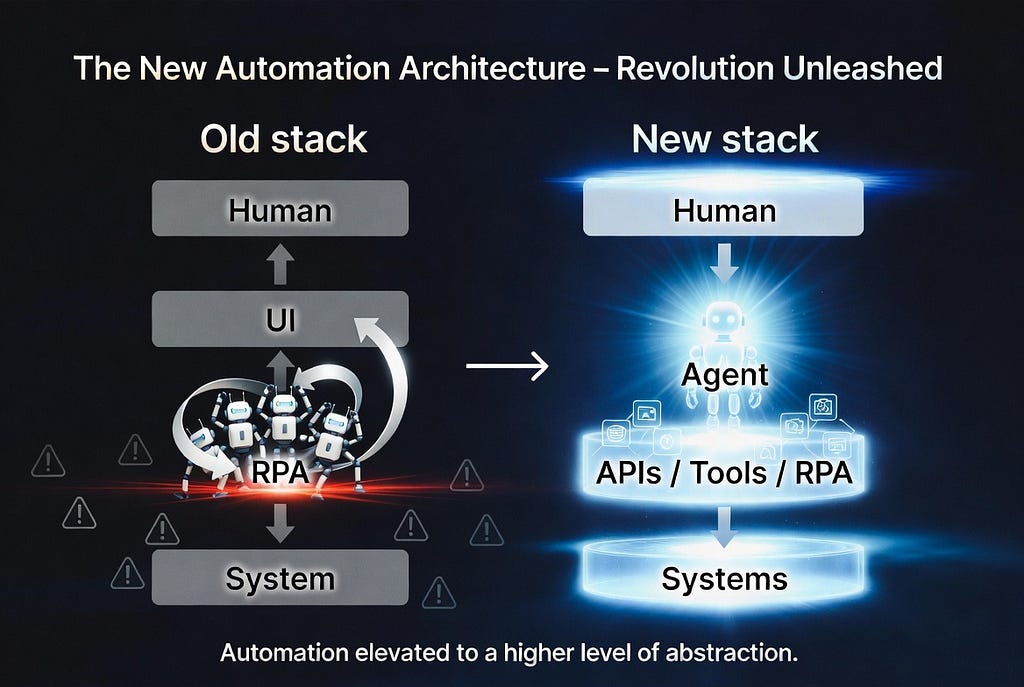
The New Automation Architecture
Old stack:
Human → UI → RPA → UI → System
New stack:
Human → Agent → APIs / Tools / RPA → Systems
Automation moved up one abstraction level.
The Real Impact
The disruptive aspect is not cost reduction.
It is operational redesign.
RPA optimized existing processes.
APA questions whether the process should exist.
When software can reason, workflows no longer need to mimic paper procedures.
Organizations stop asking:
“How do we automate this process?”
They start asking:
“What outcome do we actually need?”
Returning to Laura
In 2026, Laura still receives invoices.
But she no longer processes them.
She supervises an agent that explains:
“Vendor used outdated pricing — I corrected using contract version 3.2. Confidence 92%. Please confirm.”
Laura does not execute work.
She governs decisions.
That is the real transition:
From digital labor → digital collaboration.
Final Thought
RPA automated actions because computers couldn’t understand intent.
APA automates outcomes because they now can.
The history of automation is not about replacing humans.
It is about removing the need for humans to behave like machines.
RPA removed repetition.
APA removes interpretation burden.
The next frontier is not faster clicking.
It is delegated thinking.